Much of life-science research cannot be traced or checked.
Many results could not be repeated even before AI. Agents now produce new ones much faster.
Read the articleSelected for the Anthropic Startup Program, 2026
Models are now strong enough to do real scientific work. We are building the place where they do it, inside each lab’s own data, so they grow with the project: each session starts from what the last one learned.
Our approach
A model can now read the papers, write the analysis and run it overnight. But its answer is probabilistic: ask twice and it can differ. A result becomes research when someone can see what produced it, run it again and build on it. That takes a place to work: the lab’s own data, its tools, and a record of what was done.
Most of this record is never written down. Ask a lab, six months later, why a filter was set at 0.01 and not 0.05. The answer is often in an old chat thread or in one person’s memory. Now that agents do more of the analysis, there is more of this to lose.
Every lab has its own data, tools and open questions. The model should work inside them, on the lab’s computer. When the model, the tools, the data sources and the papers sit in one workspace, time goes to the question.
Scientists set the questions and judge what the evidence supports. Agents examine possibilities and carry out the work. Any finding stays open to challenge.
Progress is also an explanation ruled out, a limitation found, or a better question made possible.
أثر · Arabic for “trace”
Athar is our first step: a research workspace where agents work inside your project, on your computer.
It uses local models by default, and Claude or OpenAI when you choose. Each finding keeps its session, the files read and the tool calls made. Recorded tool calls can run again with no AI in the loop. Numbers with no source, and findings that contradict each other, are flagged. Questions, findings and the links between them stay with the project, so the next session starts from what the last one found. You decide what to build on.
How we keep it checkable
Record. Re-run. Replicate. Flag. You decide.
Private early access
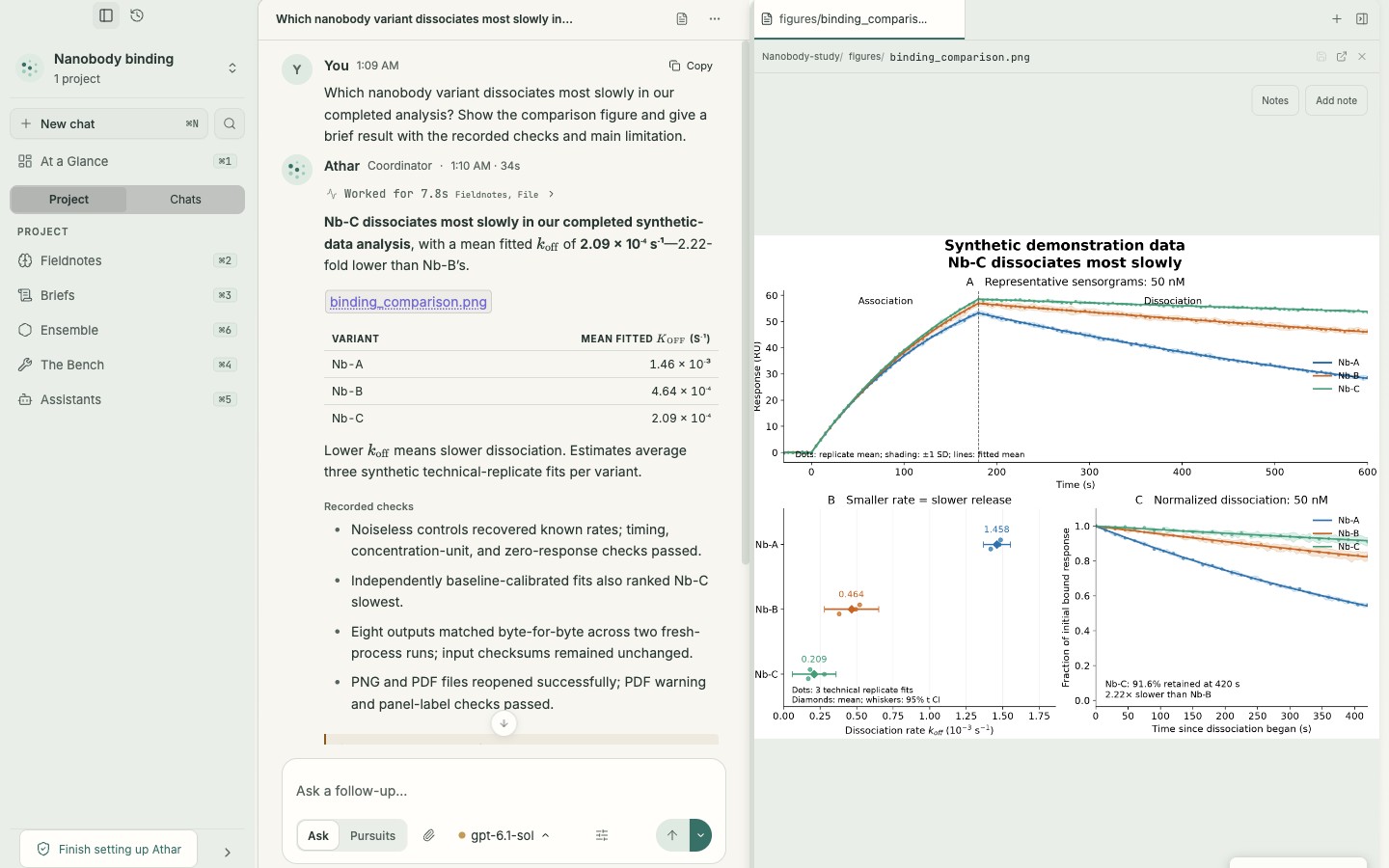
One question, through Athar
A synthetic nanobody study, from the first question to the next one.
Many results could not be repeated even before AI. Agents now produce new ones much faster.
Read the articleRecord, re-run, replicate, flag, and then you decide. What each step does, and where it stops.
Read the protocolOn the 12 tasks both solved, Athar used about half the time of OpenScience and a third of the tokens.
“We’re building toward a research lab where scientists and AI investigate together, and what they learn becomes a foundation for the work that follows.”
I started BioVantageLab during my PhD at UT Austin.
Request received
Thank you, . We will write to when a place opens.
While you waitRead the protocol →Read the article →